Rio de Janeiro Hub — Inclusive Jiu-Jitsu
DOSA's first running pilot, delivered with Instituto Fazendo a Diferença no Jiu-Jitsu · Sulacap, Rio de Janeiro, Brazil
About 85% of students are aged 3–25. Figures as of November 2026.
Who It Serves

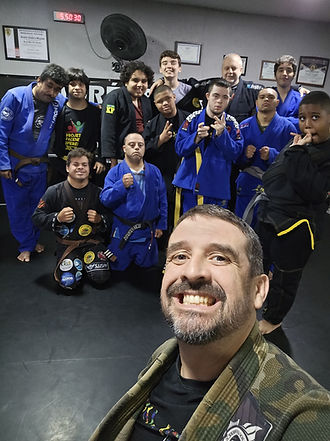
Children, youth, and adults with Down syndrome, autism (support levels 1 to 3), Fragile X syndrome, intellectual disabilities, and physical disabilities — training side by side with typical students in mixed classes. Students rarely leave; many have trained with André for years. This year, about five children with high support needs had to wait for a place because of limited space and staff.
The Method: Adapted Jiu-Jitsu + Psychomotricity
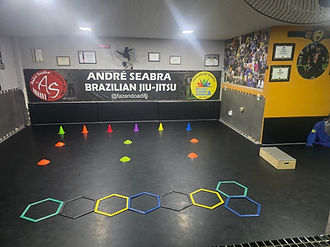
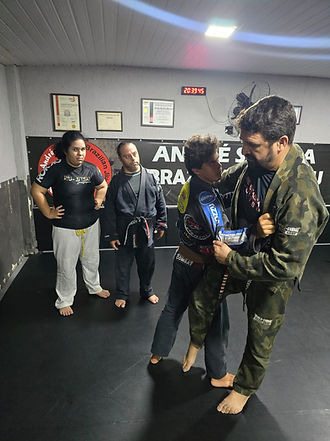
Same values, adapted teaching. Every student works at their own pace, using playful activities and psychomotor circuits to build coordination, attention, and confidence. For students with Down syndrome, rolling and neck protection come first.

- 01First contact with the instructor — acolhimento: a welcoming first conversation, the most important part of the whole process.
- 02An intake conversation (anamnesis) with the parents or with the student, depending on the disability — health, medication, interests.
- 03Direct observation of the child on the mat.
- 04Placement in the right class, mixed or small group.
Stories from the Mat

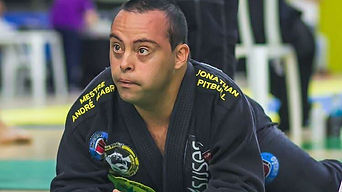
Jonathan 'Pitbull'
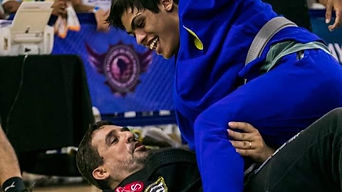
Jonathan, who has Down syndrome, first trained with André as a child around 1999 and came back as a young man in 2010. In 2017 he faced former UFC champion José Aldo in an adapted bout, and in 2020 André awarded him his black belt. Today he helps teach. In his own words: 'I used to fight at home… now I am here, firm and strong, to help my teacher until the end.'

Luigi
Luigi has Fragile X syndrome with autism (TEA) comorbidity. When he arrived he had almost no motor coordination, little interaction, and did not speak. After about four years on the mat, he speaks, interacts, and asks to go to class. His family tells the story in the documentary below.
Training days, student stories and results from the Rio hub, posted by our local partner.
Master André Seabra — Lead Instructor

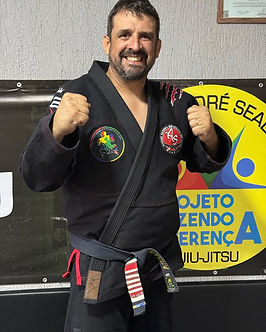
- 6th-degree jiu-jitsu black belt (2025) · 3rd dan judo
- Started jiu-jitsu in 1989 · teaching since 1996 · inclusive jiu-jitsu for three decades
- Postgraduate degrees: Autism Spectrum Disorder, Psychomotricity, Sports Neuroscience
- Postgraduate in Interdisciplinary Approach to Down Syndrome (Facuminas) — in progress
- Vice-President and Director of Inclusive Jiu-Jitsu, Sport Jiu-Jitsu South American Federation (SJJSAF)
- CBJJO World Champion (2015)
- Author of the forthcoming book "Quebrando Paradigmas com o Jiu-Jitsu Inclusivo"
"Identity as an athlete — not as a disabled person."
Partner organization: Instituto Fazendo a Diferença no Jiu-Jitsu · CNPJ 55.740.601/0001-22 · nonprofit association · Rio de Janeiro, RJ
The 12-Month Pilot: What We Will Measure
| Goal | Target | How we measure |
|---|---|---|
| Free places for students with disabilities | 40 now → 60 in a larger site | Scholarship list |
| Attendance | 70%+ of classes | Attendance sheets |
| Motor & independence progress | Baseline + every 3 months | Simple checklist + parent rating |
| Family feedback | 2 parent meetings per year | Short survey |
| Waiting list | Place 5 children with high support needs | Intake records |
| Coaches trained | 1–2 assistant instructors | Training log |
| Reporting | 4 quarterly reports + 1 annual report | Shared with funders |
Current site
40 scholarships · about $809 per scholarship
Larger, wheelchair-accessible site + 1 assistant
60 scholarships · about $871 per scholarship
DOSA funds the share of the program serving students with disabilities, plus their kimonos, belts, competitions, insurance, first aid, and safeguarding. Other students continue to pay their monthly fee. Every expense is documented with receipts and reported to funders.
See the full Year 1 funding plan →In the Press
First Fazendo a Diferença event at the Navy's CEFAN: 50 bouts for athletes with disabilities (June 2026)
Read ↗Where Year 1 Happens
Each track is a program model. Hubs are where a track runs, with a local partner.
Rio de Janeiro, Brazil
Inclusive jiu-jitsu for children and youth with disabilities
See the seven tracks →Luanda, Angola
Urban academies, inclusion & vocation hubs
Cabo Ledo, Angola
Coastal surf & hospitality pathways
Bengo, Angola
20-hectare agriculture & food-security site
Across all pilots, we target at least 40% girls and design every activity so that youth with disabilities can take part (target for planned hubs).

Keep a child on the mat
$67 a month sponsors one scholarship for a child with a disability.
All DOSA standards apply in Rio: two adults on the mat, parents on site, signed image consent, and faith shared with open hands — participation never depends on any declaration of faith. Read our Safeguarding Policy →